Low Voltage Valves

Vintage Valves running on your pedal board

A microcontroller-assisted 12AU7 valve distortion pedal designed to run from a standard 9V pedalboard power supply. Combines a traditional high-voltage valve signal path with a novel auto-bias system written in C, and a unique triode stacking arrangement that blends harmonics dynamically across two gain stages.

Overview

What it is

Auto-bias system

An STM8S0003 microcontroller running custom C firmware monitors the operating conditions of each triode and calibrates the optimal bias point with a single button press. No multimeter, no manual trimpots, no guesswork — the pedal finds its own sweet spot. Designed to run reliably from a standard 12V DC pedalboard supply, with a new revision supporting 9V operation via an internal inductor step-up.

Triode stacking

A unique blend control transitions seamlessly between single and dual triode output. Middle positions blend harmonics dynamically from the second triode, producing a saturated valve tone without the harsh fizz of conventional gain stacking. Paired with the bias and voice switches, the blend knob gives the player control over the harmonic content and feel of the distortion — something I have not seen done anywhere else.

Tone shaping

A bright control (high-pass shelving filter) manages pre-distortion bass content, greatly influencing the pedal's overall tone. A tilt bass/treble EQ with interactive mid boost/cut contour covers everything from heavy mid-scoops to raunchy blues humps. The breakup switch selects between three bias points — Classic, Hot, and Tight — while the voice switch adjusts the second triode coupling for Crunch, Overdrive, or Lead voicings.
Low-voltage theory

Running a 12AU7 at low voltages

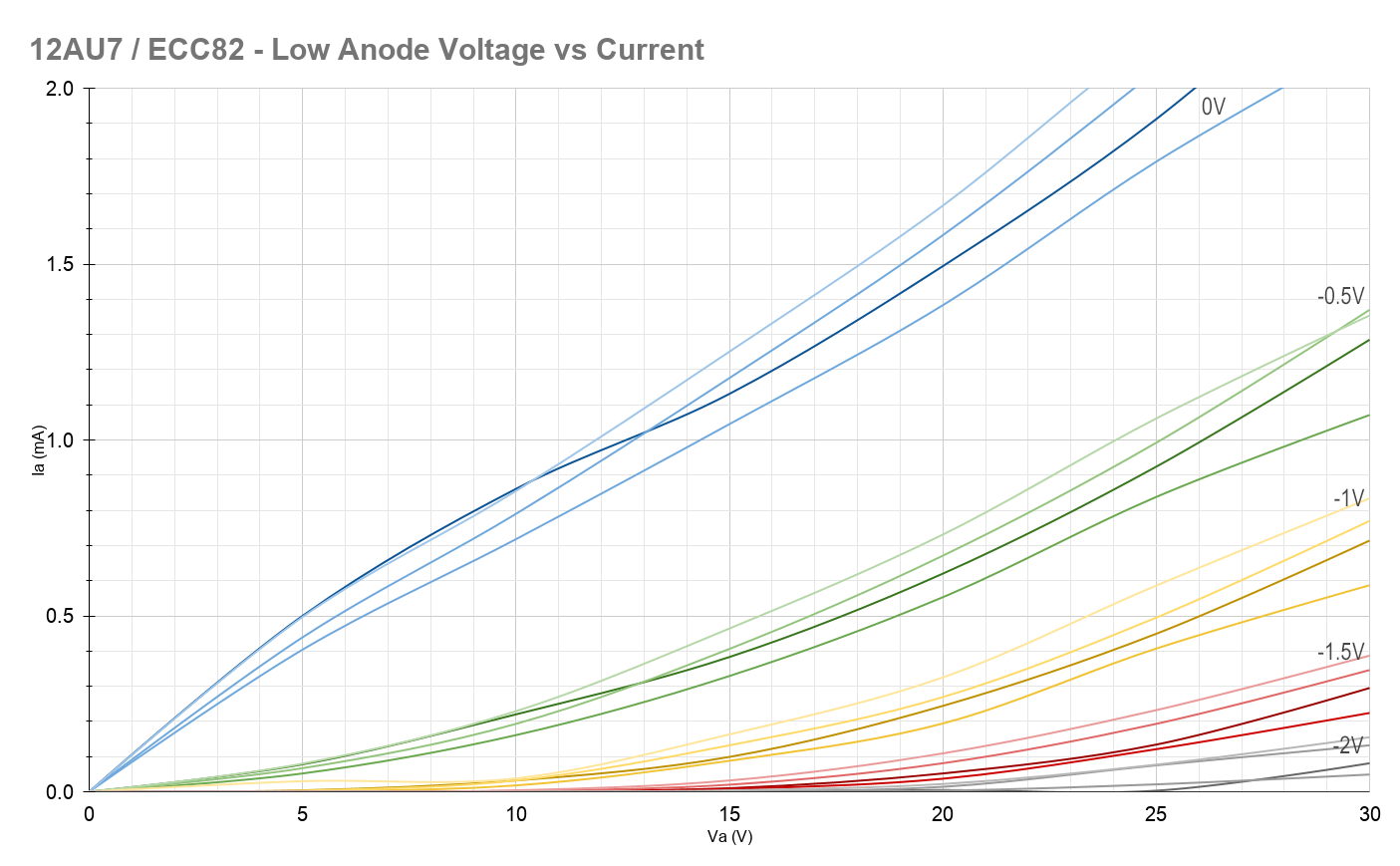
Anode characteristics for 4 different low-voltage 12AU7/ECC82 triodes
Measured anode characteristics at low operating voltages across four different 12AU7/ECC82 triodes.

Going off-grid

It is unconventional to run a 12AU7 below 50V. Datasheets hint that the valve can still amplify very small signals, but provide no useful design data for this region. To understand what's possible, I plotted it myself: sweeping the grid against low anode voltages to map the operating current.

The results are encouraging but come with important caveats. The first is small but important variations between triode currents (even within the same valve). A cathode resistor bias that works for one triode may be significantly off for another. Per-valve calibration is essential.

The grid characteristics tell another story. Grid current becomes unavoidable for even modest input signals. At the other side, grid curves bunch tightly toward -2V as the valve approaches cutoff, causing nonlinear gain. The result is asymmetric clipping with even-harmonic distortion — exactly the warm, musical character that makes valve overdrive desirable for guitar.

The physics works. The challenge is making it reliable — and that is what this pedal solves.

Under the hood

Vintage valves with digital enhancements

Low-voltage valve operation

The pedal runs a traditional 12AU7 (ECC82) valve at 23V internally, stepped up from a standard 12V DC pedalboard supply via an internal inductor. A newer revision adds 9V support at <350mA for even more flexible power options. Running at a fraction of the valve's rated 300V keeps power consumption low enough for a standard pedal supply while still delivering the harmonic character that makes valves desirable.

The whole package fits in a compact enclosure with true-bypass switching and a configurable input boost of up to 12dB. Two gain stages — single, parallel blend, or series — give the player countless distinct operating modes, and the nine-voice options (three bias settings × three coupling modes) cover a wide range of tones from warm cleans to saturated leads.

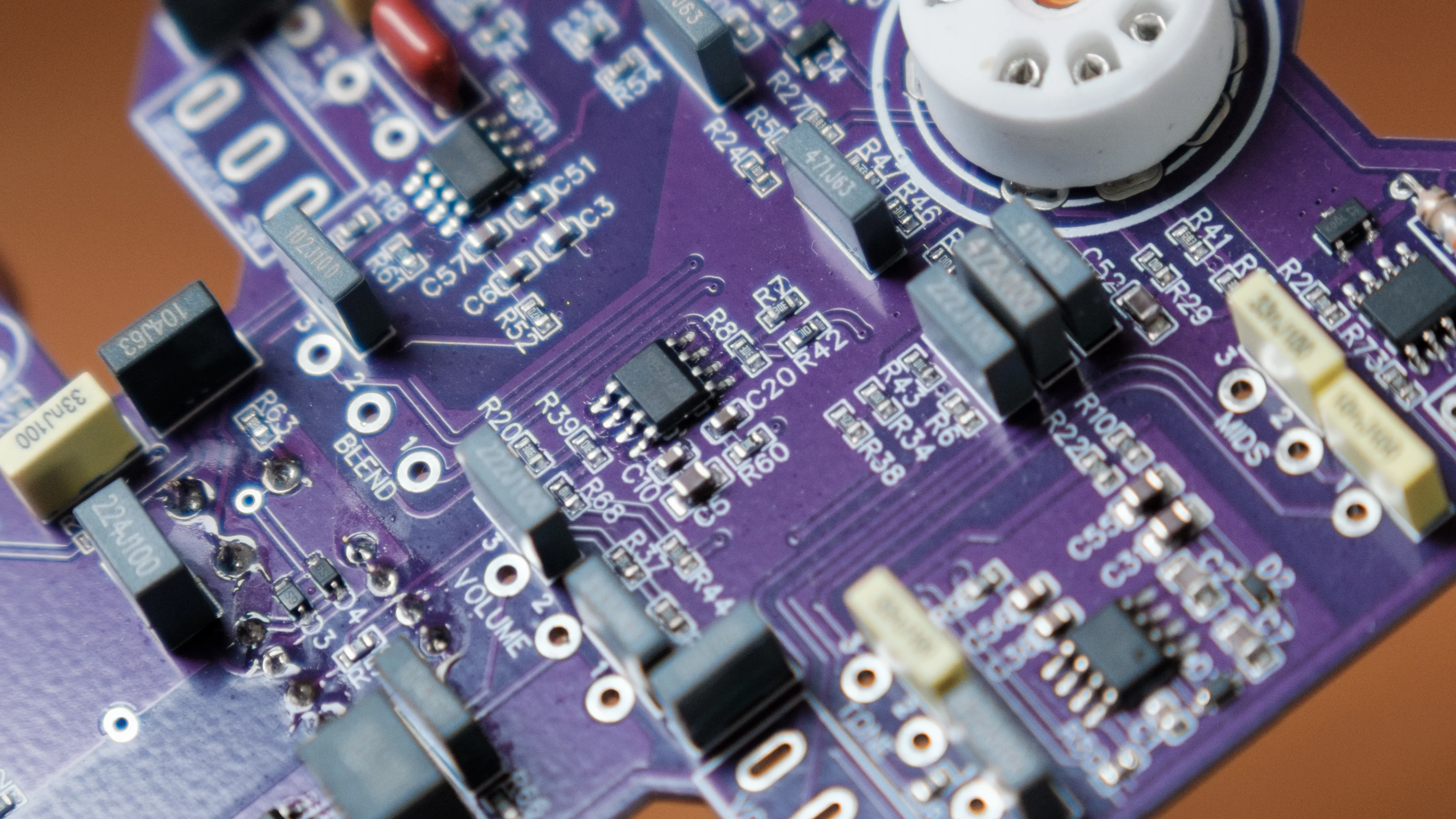
The PCB was designed from scratch and manufactured with pick-and-place component assembly, enabling a compact double-sided layout that integrates the valve, microcontroller, power supply, and analogue signal path on a single board.

Low Voltage Valve Pedal PCB showing the 12AU7 valve and surrounding circuitry
Custom-designed PCB: 12AU7 valve, STM8S0003 microcontroller, and the analogue signal path — designed from scratch and manufactured with pick-and-place assembly.

The controls

Limitless tone at your fingertips

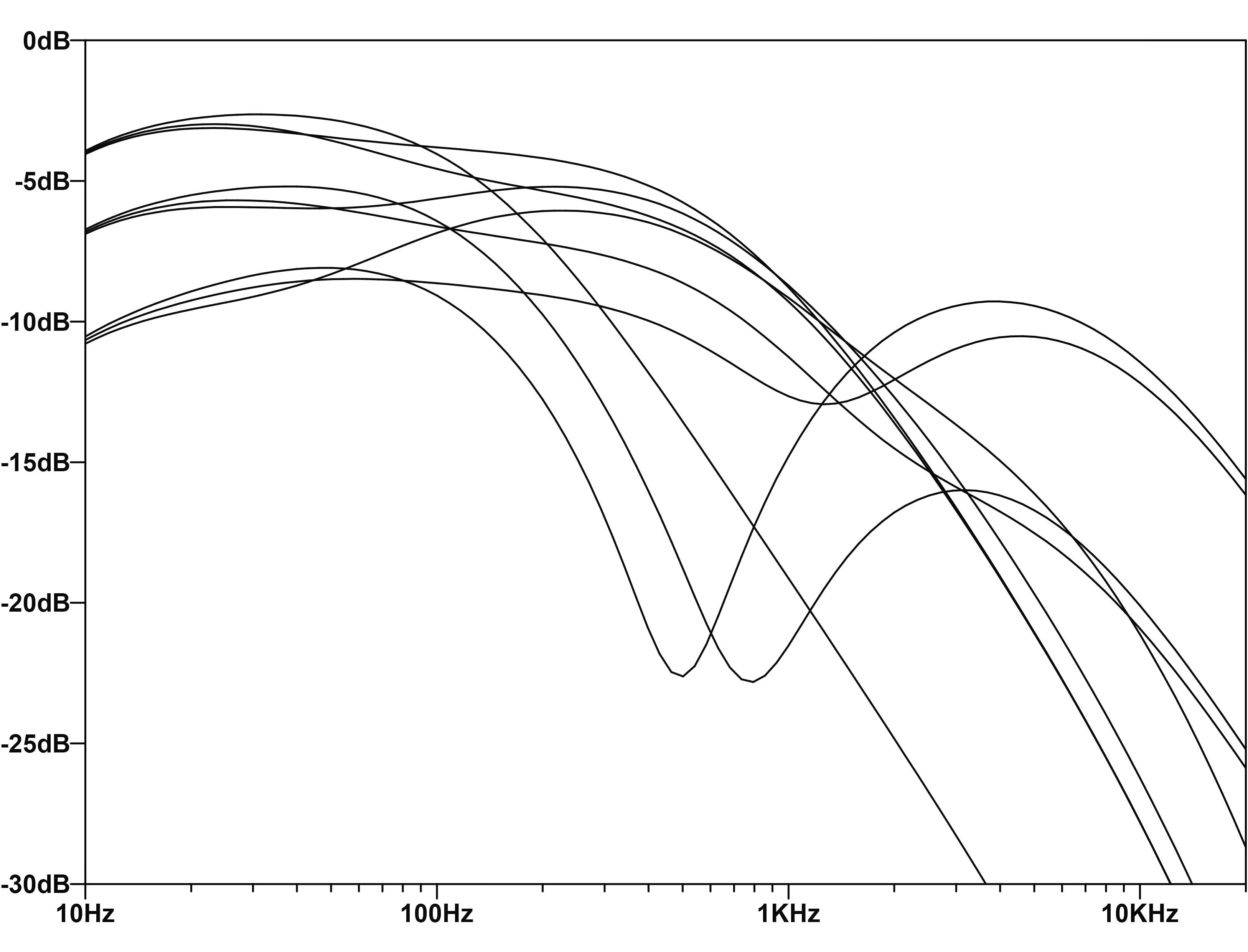
Tone stack EQ frequency response curves
Tone stack frequency response across the tilt EQ range.

Blend, bias, and voice

The voice knob is the centrepiece of this project. It controls the triode stacking arrangement and interacts with both the bias and voice switches, giving the player a huge range to customize the already nine distinct voicings from a single control. The breakup switch changes the bias point for both stages — Classic for centre-biased symmetry, Hot for grid-clipping aggression, and Tight for an anode/grid split that tightens the low end.

The voice switch adjusts the second triode coupling and the tone applied by the voice blend control: Crunch for a warmer, less high-end voicing; O-Drive for the classic valve overdrive character; and Lead for extra gain with a more aggressive top end. The bright control sits before the distortion stages, curbing bass content that would otherwise turn muddy under gain, while the tone stack presents a huge range of options in a compact dual-pot tilt/scoop configuration.

Engineering

Solving problems with low-voltage valves

Microcontroller bias and smart power supply

Biasing a 12AU7 correctly at low voltage is a key problem — even valves from the same brand draw different amounts of current at low anode voltages, making a traditional bias resistor unreliable. An STM8S0003 microcontroller solves this with a closed-loop control system: an ADC scans the anode voltage range, the firmware compares it to the target set point, and adjusts the bias voltage accordingly.

The power supply is its own engineering challenge. The revised pedal accepts both 9V and 12V DC inputs, auto-sensing which is connected. An internal inductor step-up generates a 12V rail for the valve heater and a 23V rail for the analog circuitry. The valve heater also draws significant cold-start inrush current — without limiting, the initial surge can trip low-current pedalboard supplies. A current-sensing limiter restricts the heater draw to just 160mA, meaning it can be powered without a separate, high-current plug.

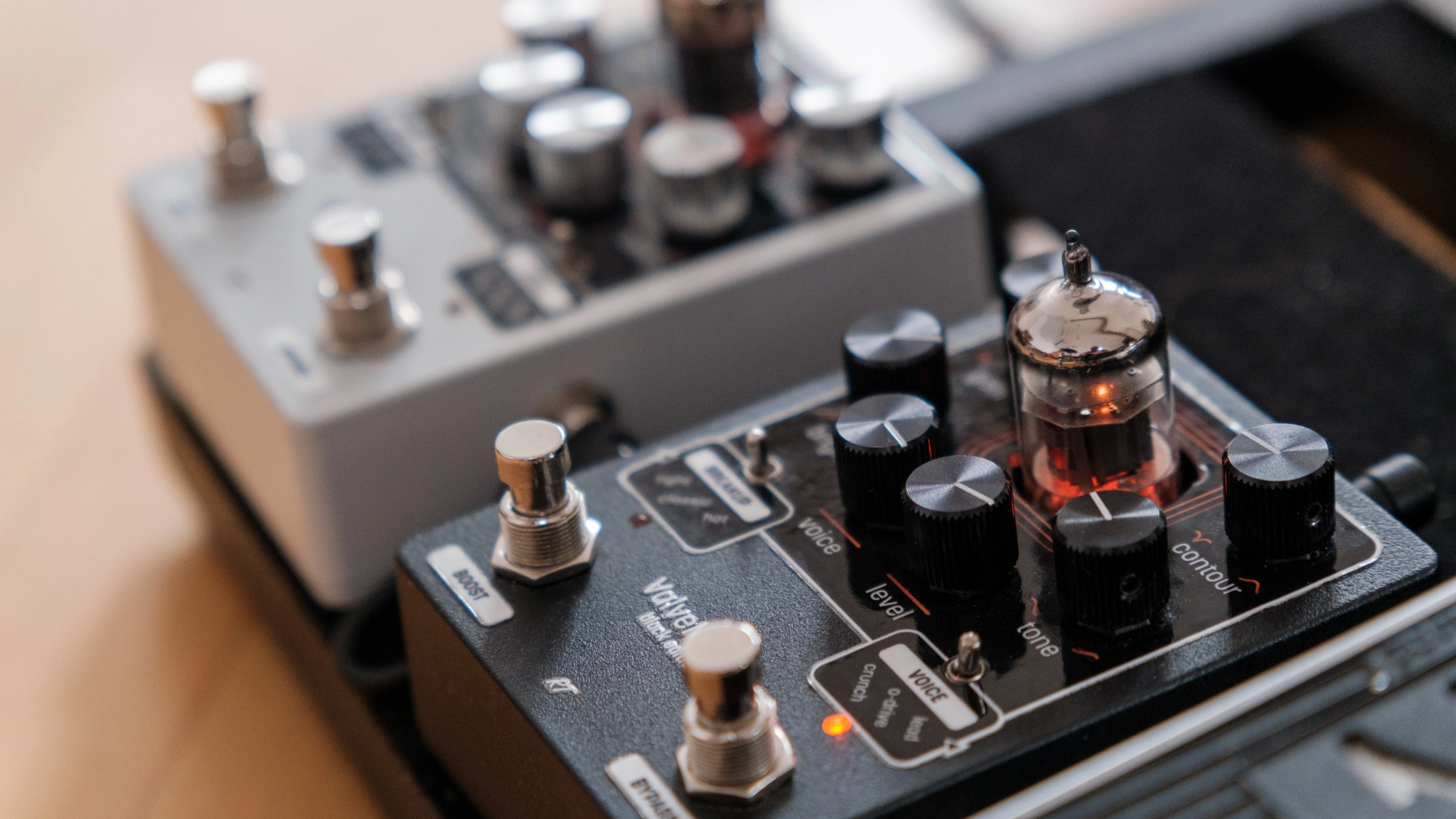
Low Voltage Valve Pedal enclosure with control layout
The prototype enclosure: blend, bias, bright, contour, breakup, and voice controls.